01
It never gets scheduled
The javax to jakarta upgrade, the AngularJS rewrite, the Oracle Forms port. Too large to fit in a sprint, too unglamorous to win a roadmap fight. So it moves to next quarter, again.
Migration & modernization workbench
Shift turns your modernization backlog into governed runs: it plans the change, waits for an engineer to approve that plan, executes in an isolated worktree, and hands back a reviewable diff and a security scan, all on your own machines.
Desktop app for macOS & Windows
Industries we support
Guest-facing systems that have to keep taking bookings while their code is modernized underneath.
Systems where every change has to stand up to audit, modernized one approved run at a time.
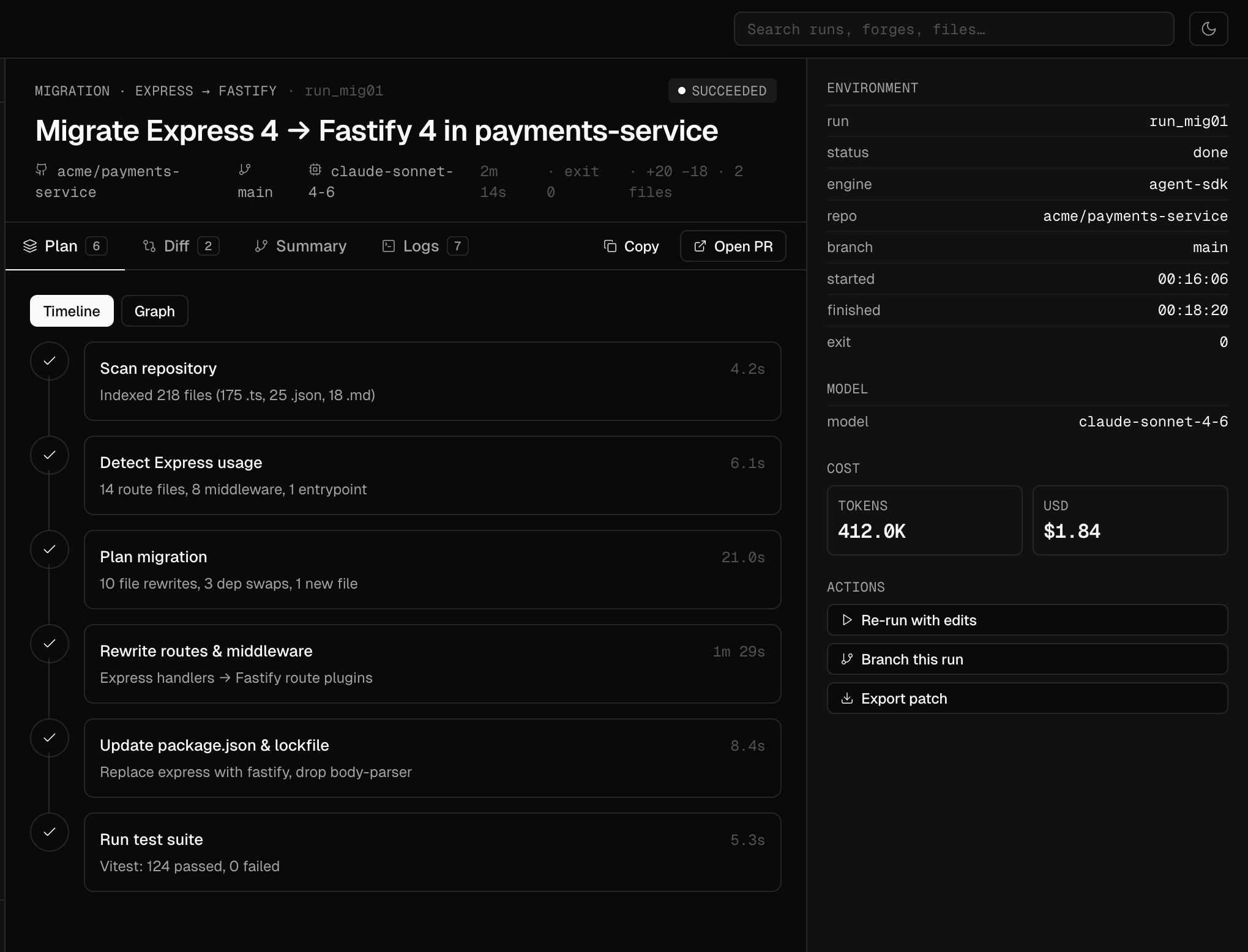
shift / workbench / run_mig01
planningMigration · Express → Fastify
Migrate Express 4 → Fastify 4 in payments-service
acme/payments-service · main · claude-sonnet-4-6
Scan repository
Indexed 218 files (175 .ts, 25 .json, 18 .md)
4.2s
Detect Express usage
14 route files, 8 middleware, 1 entrypoint
6.1s
Plan migration
2 file rewrites, 2 dependency changes
21.0s
Approval gate
Rewrite routes & middleware
Express handlers → Fastify route plugins
1m 29s
Update package.json & lockfile
Replace express with fastify, drop body-parser
8.4s
Run test suite
Vitest: 124 passed, 0 failed
5.3s
Built for the stacks your roadmap keeps deferring
The problem
Every engineering org of a certain age carries the same backlog. Your team knows exactly how to do the work. There has never been a quarter with enough capacity to actually do it.
01
The javax to jakarta upgrade, the AngularJS rewrite, the Oracle Forms port. Too large to fit in a sprint, too unglamorous to win a roadmap fight. So it moves to next quarter, again.
02
Hundreds of near-identical edits across hundreds of files. The work is mechanical at heart, which is exactly why it burns senior engineers who should be shipping product.
03
A copilot helps one engineer type faster in one file. Nobody has solved the workflow around a six-hundred-file change: who approved it, what ran, what changed, and how you would prove any of it later.
04
Change control wants a plan, a named approver, an isolated execution, a diff and an audit trail. Ungoverned AI output clears none of those bars, so the work stays exactly where it was.
Shift exists for that gap: the change is mechanical enough to automate, and consequential enough that it has to be governed.
The product
A run is the unit of work. It starts as a sentence, passes a human gate, executes in isolation, and finishes as a diff your reviewer can approve like any other pull request.
The workbench is the home screen: every run across every connected repository, what is queued, what is running and what failed. Start a new one from three modes, or reopen a past run and branch it.
shift / workbench
Workbench
Good morning.
5 runs · 0 currently running.
Migration
Move between stacks or versions.
Modernization
Refactor without behavior change.
Greenfield
Generate a new project.
Recent runs
Webpack → Vite in billing-dashboard
run_queued
acme/billing-dashboard
MIGRATION · WEBPACK → VITE
1m ago
Open
Scaffold usage-metering service
run_gre01
(new repo)
GREENFIELD · NEW SERVICE
4m ago
Open
Bump Spring Boot 2.7 → 3.3 in billing-web
run_mod01
acme/billing-web
MODERNIZATION · SPRING BOOT 2 → 3
19m ago
Open
Migrate Express 4 → Fastify 4 in payments-service
run_mig01
acme/payments-service
MIGRATION · EXPRESS → FASTIFY
47m ago
Open
Convert legacy-jboss to Spring Boot 3
run_failed
acme/legacy-jboss
MODERNIZATION · JBOSS → SPRING
5h ago
Open
Pick a repository and a branch, choose migration, modernization or greenfield, and say what you want. Or start from a template that already encodes the migration.
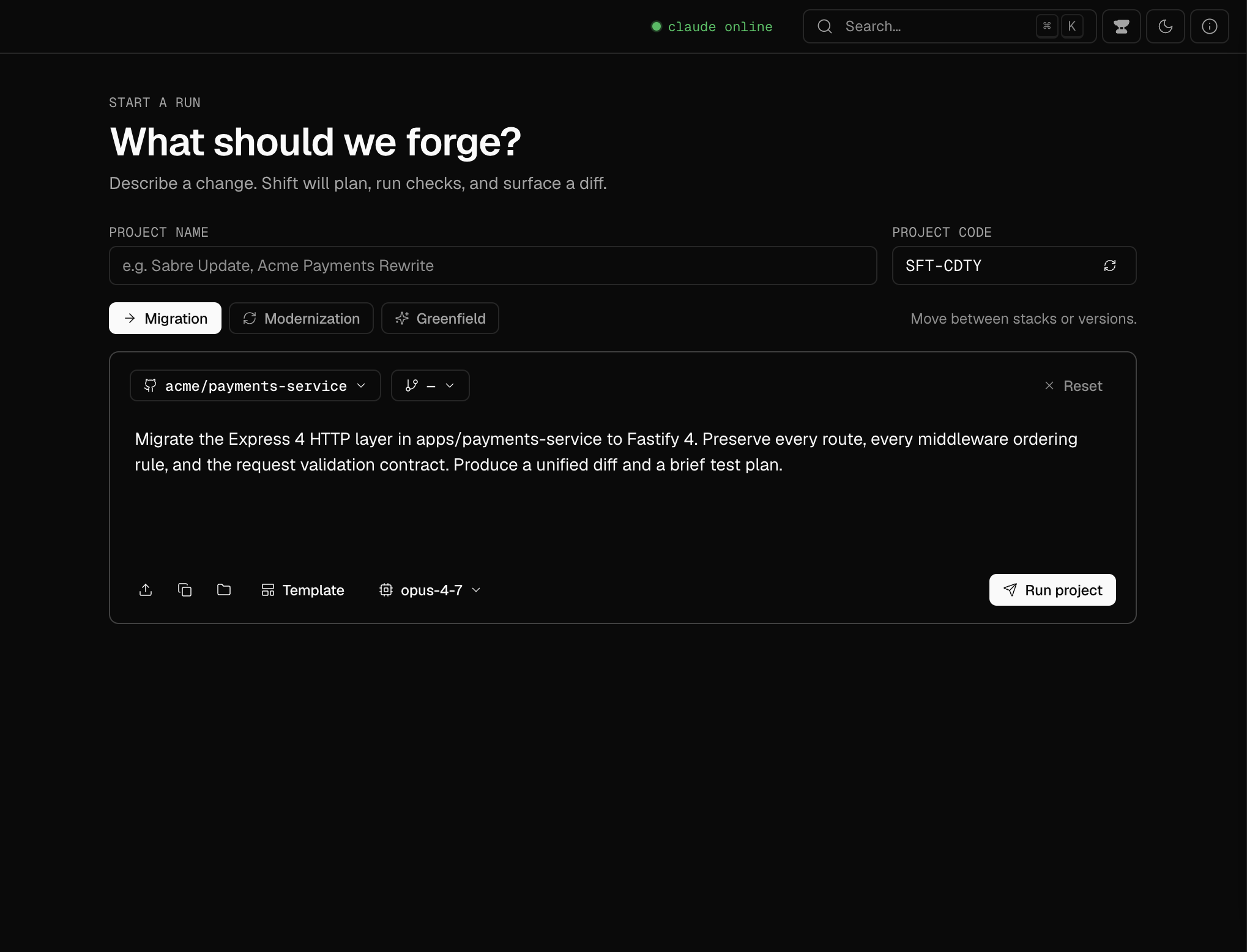
Shift indexes the repository, detects what is actually in use, and proposes a step-by-step plan with file counts and expected durations. Not a single line is written until a human approves that plan.
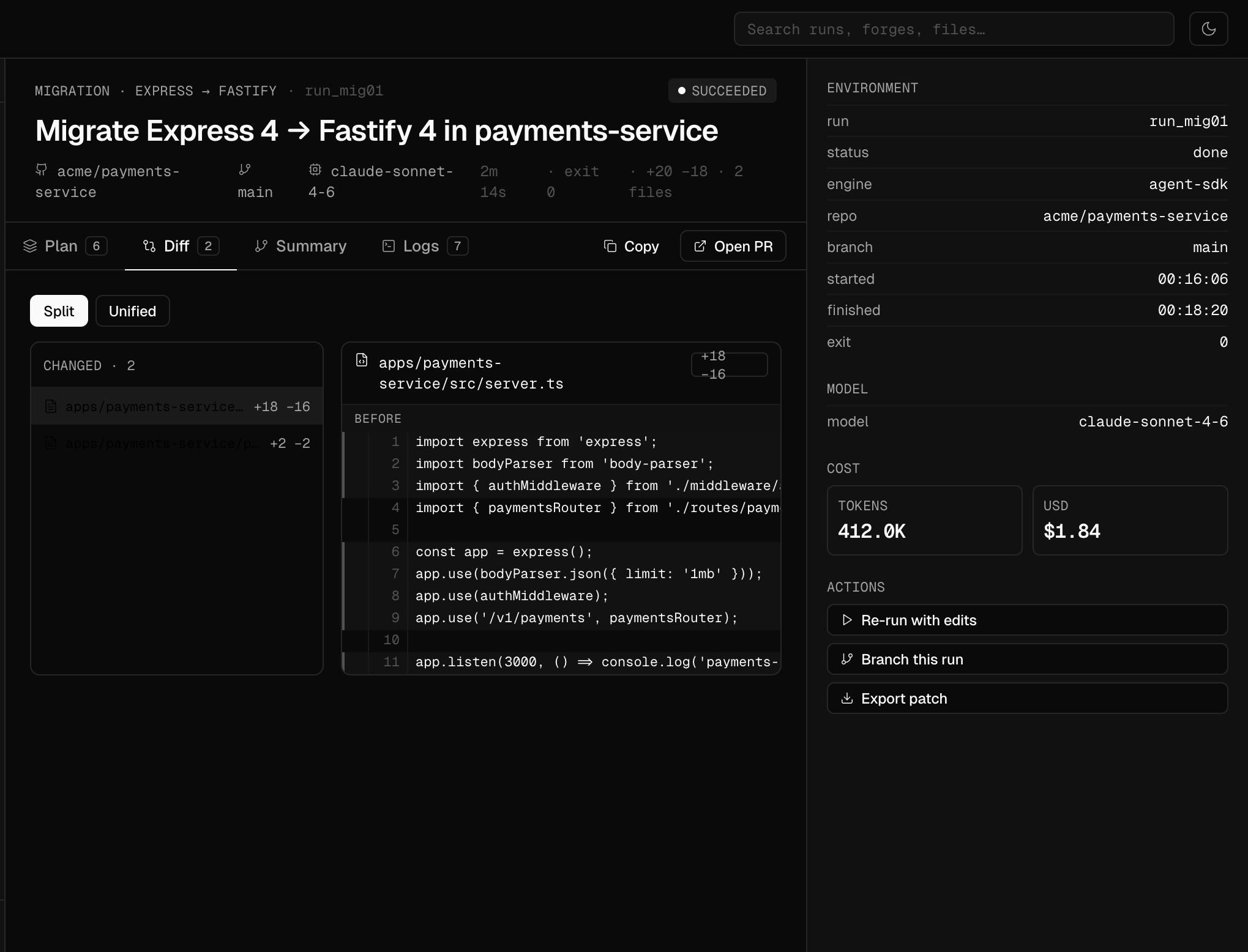
Execution happens in a throwaway git worktree, so your checkout and your branch are never touched. What comes back is a diff (split or unified, per file, with line counts), reviewed exactly the way your team already reviews code.
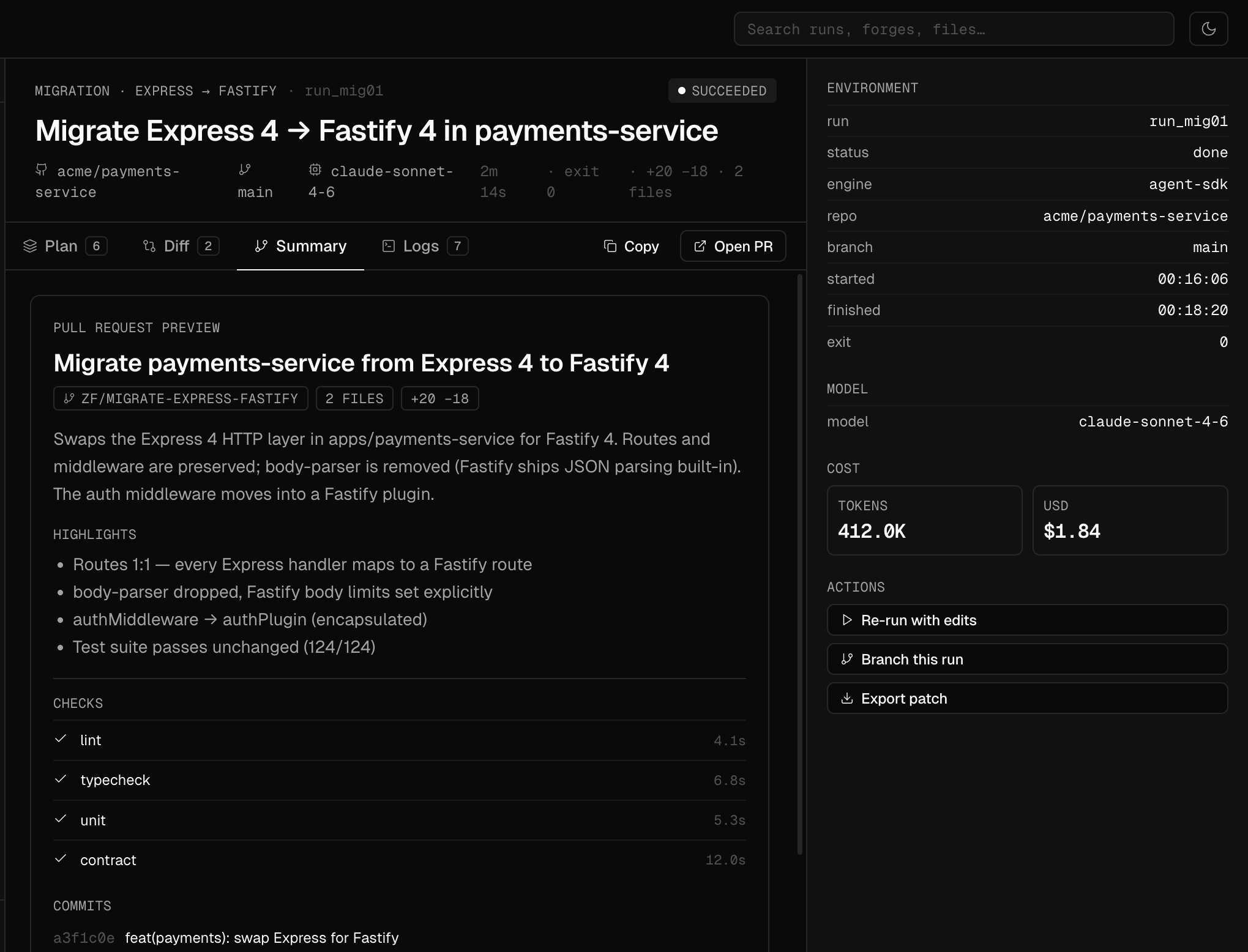
Highlights, a check matrix with durations, and the commit list, all generated from what the run actually did rather than written by hand afterward. This is the artifact that goes to change control.
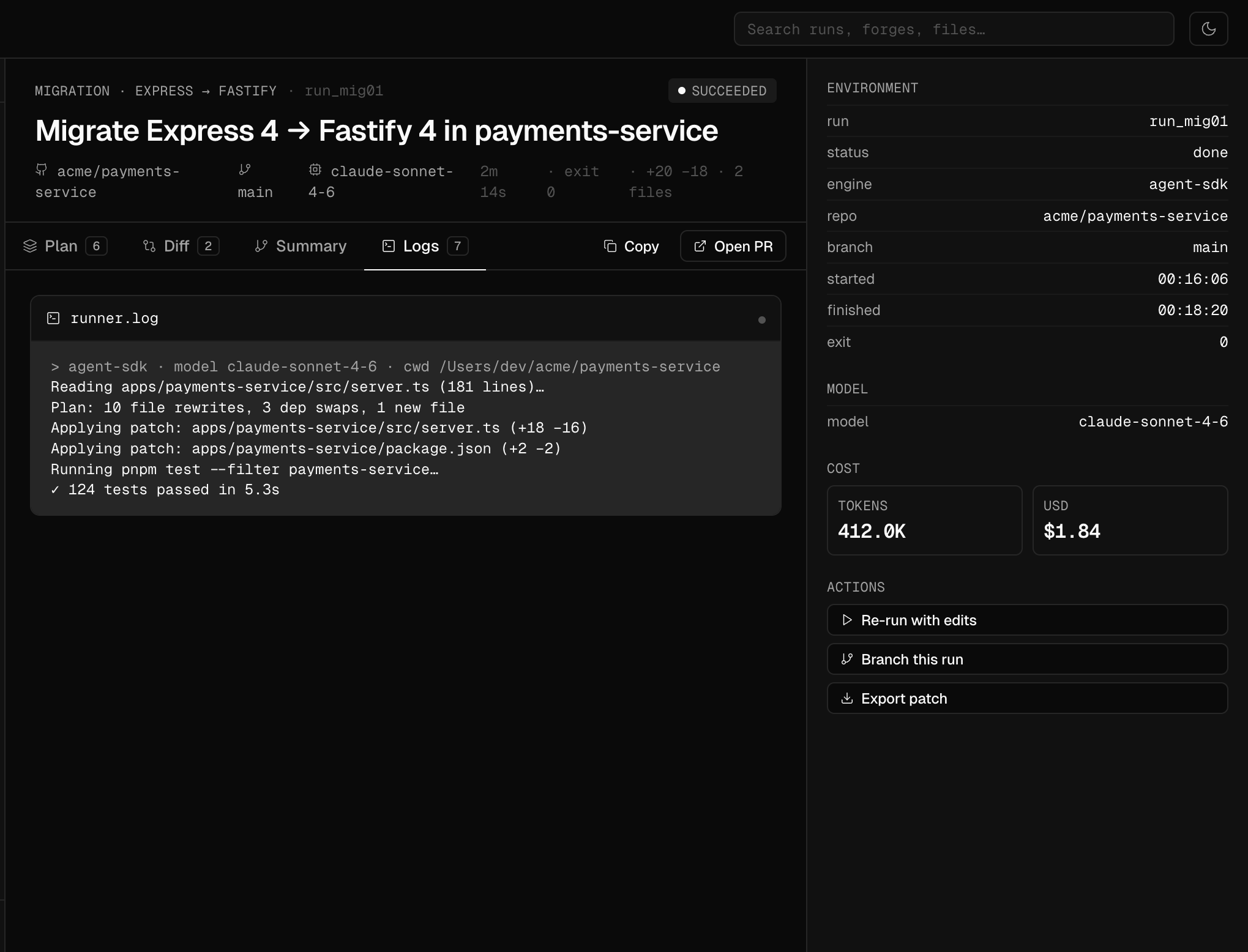
Every command the run issued, in order, kept with the run. Alongside it a token and USD meter, so spend is visible while the work is happening rather than as a surprise on an invoice at the end of the month.
Stage 1 of 6
How it works
Every run is a governed workflow, not a prompt. The engineer approves the plan before any code is written, and reviews the diff before anything merges.
Shift proposes an executable plan with target files, risks and rollback notes. No code is written yet.
Your engineer or tech lead approves the plan, or sends it back with notes. This is a hard gate.
The work runs in an isolated git worktree. Your checkout and branch are untouched.
A reviewable diff lands together with a security scan. Findings are severity-graded.
Your engineer merges, with the prompt, plan, diff, logs and scan retained as evidence.
Template library
Templates carry the prompt, the constraints and the checks for a known move, so the first run on a new repository is not a blank page. Anything not in the library starts as a plain description instead.
Move between stacks or versions
Update what stays in place
Enterprise migrations (Oracle Forms, COBOL adapter layers, Salesforce, Kony, .NET Framework) are delivered as scoped migration templates built with you during the engagement.
Where teams point it
The starred items are what enterprise teams are asking for most right now. Everything here is delivered the same way: one contained workflow, plan-gated and reviewable.
Migrate
Move onto a new stack
Salesforce and CRM platform migration
Oracle Forms to a modern web front end
Modernize
Update what stays in place
COBOL and mainframe adapter layers
Integrate
Make it talk to the new world
ISO 20022 message and schema work
Open Finance and open banking APIs
Salesforce migration is where most teams start.
Why it clears security review
These are the three answers that decide whether a modernization tool gets through vendor risk, in any estate where data residency is a regulatory question rather than a preference.
Shift runs inside your own environment. Your repository is never uploaded to a vendor cloud, so using it adds no new place your code is stored or processed.
No change is written before a human approves the plan, and no change merges before a human reviews the diff. The gate is structural, not a setting that can be turned off.
Every run retains the prompt, the approved plan, the diff, the logs and a severity-graded security scan. The audit trail is a by-product of how the tool works.
The question we get asked most
“How is this different from the AI coding tools our developers already have?”
Those help one engineer write lines faster inside an editor. This owns the workflow around the change: it plans it, waits for approval, executes it in isolation, and produces the diff, the scan and the evidence. Different problem, and they run alongside each other.
Commercials
Priced per engagement, never off a rate card. Each engagement is scoped to what it actually covers, so the number reflects your estate.
Start
Outcome-priced
Scale
Annual engagement
Extend
Program plus delivery
Two things that do not change
You bring your own model account, so you see the usage meter directly and we take no margin on it. And there is no per-developer meter anywhere in the model, because we do not want a price that rises simply because your team got faster.
Four weeks. One repository. KPIs agreed before we begin.
Week 0
We scope one contained workflow and agree the KPI ranges together, in writing.
Weeks 1 to 3
Zapcom engineers run the workflow through Shift alongside your team.
Week 4
We report against the agreed ranges and hand over the full evidence pack.
Next step: 20 minutes on whichever modernization workstream is absorbing the most engineering time right now.
or write toZapforge@zapcg.com